

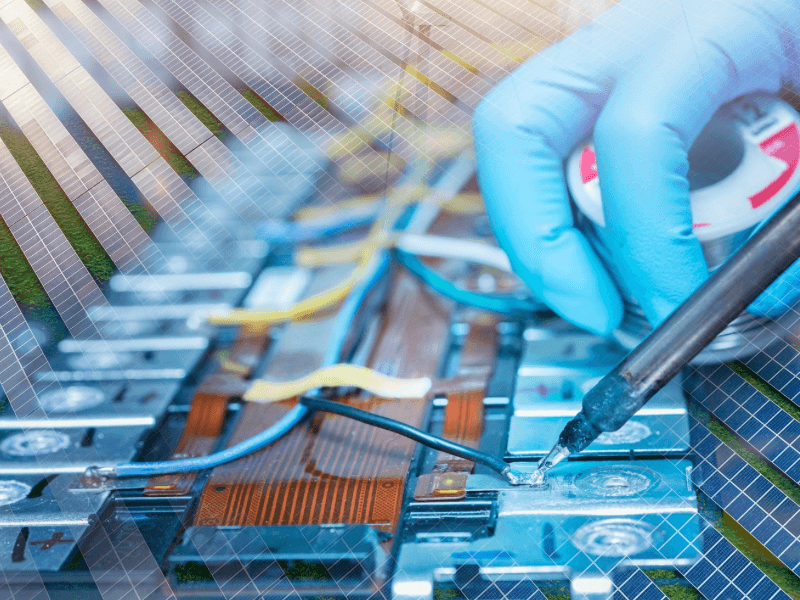
Electric Vehicles (EVs) are increasingly popular in Europe on the back of steady technological advances and supportive government policies aimed at countering climate change
Lithium-ion batteries (LiB) are powering this green revolution, providing a rechargeable, high-energy power source that is far superior to any other commercially available battery option.
The market for LiB is projected to hit $100 billion by 2025, up from US$30 billion in 2017. But this journey has not been without challenges. Manufacturers are ever on the lookout for ways to scale up LiB production quickly and affordably to meet demand, but they must do this while adhering to the quality and safety control requirements of a potentially dangerous and volatile energy source. Lithium-ion batteries must be handled with care, and a meticulous approach to the early-stage production process is paramount. This is why science must be applied if the LiB-reliant EV industry is to evolve sustainably and successfully.
The case for scientific instrumentation
The main problem with LiB is that they are prone to overheating and blowing up, potentially precipitating fires that can destroy an entire vehicle. Less dramatically, they are also liable to a short life span due to the constant recharging that must be done.
Lithium-ion technology has downsides when it comes to the environment as well. Extracting the necessary raw materials requires large quantities of energy and water. To make one ton of lithium requires about 500,000 litres of water and can have collateral side effects such as the poisoning of reservoirs and associated health problems. The conditions for the mining of Lithium at scale are notoriously unsafe for workers. Better recycling and an increased lifetime of LiB is therefore crucial if we are to minimise the need to mine huge quantities of its raw materials.
Scientific instrumentation of LiB addresses all these challenges. Using scientific instruments, a systematic approach can be meticulously applied to obtain the highest quality of LiB, with the best levels of homogeneity and safety. When recycled in a laboratory, batteries are sealed and degassed. This is necessary both for performance and safety reasons and means they cannot be opened for repairs in a mechanic’s garage. When a battery’s lifetime is finally over, and it needs to be replaced by a new unit, it must undergo a process in which it is reduced, shredded and recycled. This process is constantly being fine-tuned as part of the need to meet ever-increasing demand, and also to balance both economic and ecological considerations.
The right instrument for the job
The right scientific instrument is always fundamental to obtaining the data needed for the quality assurance and quality control (QA/QC) of any material. In the case of LiB, that job is split into various parts. A battery has two electrodes (anode and cathode), and a separator layer which divides the electrodes from each other. There is an ion-conductive electrolyte that fills the pores of the electrodes and the space inside the cell.
The production of LiB is a complex process that involves several key steps, with high precision required for ensuring the final battery’s quality and performance. The systematic scientific process for LiB manufacturing is as follows:
- Mixing – the precursor materials for the cathode and anode are combined, making slurries where they react leading to small particles of the final materials. The production of slurry requires not only active materials but also conductive additives, solvents, and binders.
- Coating – next these particle slurries are coated onto the current collector through pipework or in sealed storage tanks.
- Roll pressing – electrode layers are flattened evenly by pressing, so homogeneous layers can be built.
- Cutting – by slitting and notching, electrodes are cut into battery-size pieces. This process involves cutting the sheets to the desired size and alternating anode and cathode layers with others, like membranes or isolates, in a cake-like fashion. This accumulates the maximum amount of energy in the minimum possible weight.
- Cell assembly – electrodes and separator films are stacked to build the pouch battery. Electrode cutting can be performed using a mechanical punching approach or laser separation technique.
- Injecting – the electrolyte is placed into the cell with the aid of a high-precision dosing needle, ensuring proper vetting under vacuum conditions. It’s a critical step due to safety and quality considerations.
- Formation – the first charge of the cell, crucial for Solid Electrolyte Interface (SEI) layer formation and battery performance. When charge-discharge cycles are performed, the batteries are allowed to stabilise.
- Degassing – the process of electrolyte degassing is then carried out in a vacuum to ensure the Lithium-ions can move freely, enabling efficient charging and discharging. The gas formed during charging, especially in pouch cells, is removed to diminish the possibility of a fire hazard. If the degassing step is omitted, a large portion of the gas evolved is consumed over time. It is also essential to remove gases and contaminants to retain the purity of the electrochemistry for optimum performance and long life of the battery cells.
- Cell finishing and aging – Cells are monitored under controlled temperatures.
- Final Inspection – the finished product should be given a thorough final inspection inside an air-tight casing, with metallic connectors to the anode and cathode layers.
- Testing – before shipping, the LiB should be tested several times with charging and discharging cycles.
Each step must be scrutinised and examined using the most appropriate technique. For example, anode and cathode particle size and composition in the first step has to be observed using scanning electron microscopes. For every step, skilled scientific instrumentation experts will identify the most crucial quality features, and the most delicate and prone to failure.
Apart from traditional temperature or humidity monitoring, production control of LiB may require the use of metallographic optical microscopes, hardness testing, or high-tech devices such as electron microscopes equipped with electron diffraction spectroscopy. The use of such techniques also demands specific sample preparation methods, such as precision cutting saws, mechanical or electrochemical polishing, and focused or broad ion beam instruments.
The absence of defects or contamination can only be determined by quality control procedures, which are performed by scientific personnel in manufacturing facilities, sometimes in their own QC labs through sampling, and sometimes in-line, in other words in real-time during the production process in an automated way.
Quality results have to be documented and be traceable for every step, as buyer companies must audit their manufacturers to ensure that they don’t cheat and that they’re buying reliable and safe materials. The finished good, whatever it is, should be delivered with test results. There are a lot of regulations and paperwork surrounding quality and safety. Sometimes, there can even be one or more “official” analysis techniques that are mandatory in a particular region.
The benefits of rigorous science
In the rapidly evolving Gigafactory environment, manufacturers are eager to achieve more from their LiB battery production for productivity, scale in demand, cost efficiency, and sustainability. By ensuring product quality early on in production, it is possible to achieve these goals.
The benefits of rigorous liB scientific instrumentation for gigafactories include:
- Avoiding defects in the production process that result in product scrappage and unnecessary costs that would have been avoidable had defects been detected earlier in the manufacturing process.
- Eliminating lithium-ion cell fires that can occur under conditions of mechanical, thermal, or electrical stress or abuse.
- Certifying the compliance of the final product so that it meets target technical specifications and tight regulatory requirements. The EU’s Batteries Regulation became law in July 2023 and contains obligations that require companies to identify, prevent and address social and environmental risks linked to the sourcing, processing and trading of raw materials such as lithium. The manufacturer must comply in drawing up certain technical documentation as proof and is subject to surveillance.
- Guaranteeing the incoming finished product is delivered to specification to avoid customer complaints, refunds, and costly reprocessing.
Well-implemented, end-to-end scientific instrumentation analysis helps uphold quality across a wide range of production processes, from the processing of raw materials and production quality control to final inspection. It is important to remember that even very small defects can significantly impact the performance of the final product, its lifetime, or even its safety.
Taking ethical responsibility
Lithium-ion batteries are crucial not just for powering the EV market but enabling our modern world and ensuring a low-carbon future for us all. It is in everyone’s best interests to ensure that these batteries are safe, clean and long-lasting.
Recycling and increasing the lifetime of LiB is key in reducing the need to mine huge quantities of the precious material and so reduce its impact on our planet. LiB scientific processes and product quality are important parameters affecting the operational lifetime of final products and their durability.
Advanced scientific analytical techniques are also behind new developments in alternative battery science, helping to manage the lifecycle of these batteries responsibly. For example, rapid developments are already well underway in the use of blockchain technology for real-time data insights and the tracking of raw materials. This helps with collecting data on battery conditions and performance, from when the raw materials are first mined through to actual use in an EV battery.
It is essential for policymakers, and industry stakeholders to remain vigilant in their assessment of the most environmentally sound options for the future of electric-powered vehicles. When it comes to lithium-ion batteries, the industry must invest in alternative solutions, while in parallel remediating and reducing the impact of lithium mining. Recycling and increasing the lifetime of these batteries is key in reducing the need to mine huge quantities of a finite and valuable material. This effort should be accompanied by new lithium mining operations with strict environmental laws and regulations and investment in advanced mining methods capable of extracting lithium from seawater.
By Thierry Grenut, Sales Director, Milexia France (Scientific Instrumentation BU)
As seen in Electro Optics, July 2024
Recent posts in In the Media

Why the Future of High-Power Test Benches Must Be Fully Integrated and Automated
How integration and automation are essential for turning testing from a downstream activity into a strategic enabler.

Beyond the Surface: How acoustic microscopy transforms electronic inspection
Find out more about how this non-destructive tehcnique is being used to reveal subsurface structures with micrometre precision.

Milexia: A European Leader in Value-Added Distribution of Electronic Solutions
This cutting-edge expertise now benefits a wide range of customers.
Automated high-power test benches: Building resilient systems
As an expert in the industry, Jaafar Saied shares how innovations in high-power test benches are dramatically changing testing systems.