


In recent years LPN, PTP and GNSS technologies have been evolving rapidly, greatly changing expectations and requirements around them.
For instance, it used to be that LPN (Low Phase Noise) references were once a luxury of satellite operators and engineers – and while it was nice to have, it was by no means a necessity.
A decade ago, PTP (Precision Time Protocol) was a cutting-edge development, but it’s now evolved into an industry standard in the form of SMPTE 2110. GNSS antennas, on the other hand, were installed to support the operation of precise timing, but these were often used without consideration of threats towards the antenna and how to mitigate against them.
In this article, we will discuss the current technical requirements for these technologies, how they are mandated in many future system designs, and how new solutions such as the SyncServer S650 can deliver on these with ease.
Low Phase Noise – LPN Technology
LPN references, that were once considered by many a luxury, have become the backbone of modern high reliability satcom systems.
When system performance fluctuates, one of the common sources of the problem is the system reference. Users and operators alike try to squeeze as much performance out of a connection to reduce the needs for higher bandwidth than they require.
However, the downside of this is as you reach the edges of the performance window, issues begin to occur. BER can start to increase to unacceptable levels, signal demodulation can degrade, and data rates can reduce below SLA requirements, all of which could be prevented.
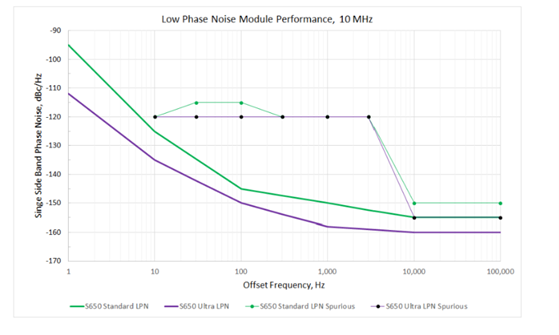
The chart below demonstrates the noticeable performance gains between system references of standard phase noise, low phase noise and ultra-low phase noise.
Low phase noise module performance
Precision Time Protocol – PTP Technology
SMPTE 2110 is both the today and the future of broadcast networks.
Of course, PTP generally is not all that new having been deployed in hundreds of thousands of systems globally. The benefit of this widespread use is that the satcom and broadcast industry can learn lessons from sectors such as financial services and telecoms, that are leveraging this technology in more reliable deployments.
PTP, while being a protocol, is a measurable protocol, in that the stability, accuracy and resiliency of the PTP source is a critical path to the fundamentals of stable operations. This can be demonstrated in the example below showing that not all PTP Sources are the same.
Ultimately, this means that even if a system provides a SMPTE 2110 reference, they should be verified, stressed and tested to ensure the peaks and demands of a growing network deployment can be withstood.
PTP sources
| Operating System | Protocol | Synchronization | Excursions |
| Linux (Intel 64-bit Kernel 2.6.30 or later) HW TS | PTPv2x | < 5 nanosecs | Rare |
| Linux (Intel 64-bit Kernel 2.6.30 or later) HW TS | NTP | ~ 10 nanosecs | Rare |
| Win10, Server 2012R2 / 2016 / 2019 | PTPv2x | ~ 1 µs | Rare |
| Vista, Server 2008, Win7 | PTPv2x | < 100 µs | Regular |
| Win10, Server 2012R2 / 2016 / 2019 | NTP | < 500 µs | Occasional |
| Vista, Server 2008, Win7 | NTP | 1-100 ms | Excessive |
Global Navigation Satellite Systems – GNSS (GPS) Technology
Full unrestricted access to GPS was made available in the year 2000, and it changed the fundamental way in which precise time was delivered to users.
As a result, low-cost GPS receivers would replace expensive atomic clocks, leading to accuracy and flexibility improving dramatically, and with it everything generally getting a little bit easier.
As GNSS technology rose in use and popularity, systems and protocols advanced to ever greater levels of accuracy, thus underpinning the operation of so many broadcast and communication systems.
But, while the weaknesses of GPS were acknowledged as far back as 1983, they were never truly exposed or exploited until recent years. As of 2025 there has been significant body of evidence towards deliberate jamming and spoofing (manipulation) of GNSS signals, within both military and civilian spheres.
GNSS interference
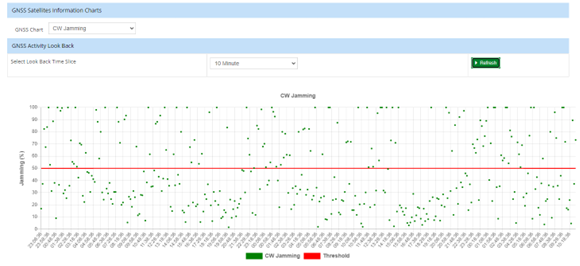
It is clear from these findings that GNSS Systems can no longer operate with impunity, and thus without consideration, towards threats that they may face.
They must be consistently monitored for both jamming and spoofing. Both of which can cause significant operational headaches and ultimately denial, and/or loss of service, to their wider connected system.
Conveniently the Microchip SyncServer S650 has all three capabilities in one system, with Microchip being the market leader in timing systems for over 30 years. As well as having been deployed in some of the harshest, most challenging environments that could be imagined
Meet us at the International Broadcasting Convention (IBC) 2025
Milexia UK is excited to announce it will be exhibiting at IBC 2025 from 12-15 September. Come visit us on Stand 1.A63 and meet the team! We’ll be hand on hand to discuss the latest innovations in GNSS, LPN and PTP and how these technologies can transform your operations.
Book a meeting with one of our experts here: https://azure.milexia.com/event/join-milexia-at-ibc-2025
Recent posts in Group News

Discover Milexia’s range of cutting-edge technologies from our Partners
IBC 2025 runs from 12-15 September at the RAI Amsterdam Convention Centre, with over 1,400 exhibiting companies and more than 45,000 professional visitors.

Enensys’ IPGuardX Real-time Failover Switching product
IPGuardX is a software-based automatic Internet Protocol (IP) changeover solution from our trusted technology Partner Enensys, which offers a range of different benefits for network operations.

Assured PNT: keeping critical operations on track
Global navigation satellite systems are essential for defence, telecom, power grids and autonomous platforms — but they’re vulnerable to jamming and spoofing. Assured PNT from Septentrio, delivered by Milexia, ensures centimetre-level accuracy and real-time interference rejection, with expert local support for integration, prototyping and deployment.

Milexia Group strengthens its offering.
Milexia Group strengthens its offering by reinforcing its sourcing activities and delivery services. This will simplify customers’ procurement, globally.