

Vista 300
Vista 300 is the most advanced nano-chemical meteorology instrument for R&D and failure analysis in nanofabrication.
This product is available from Milexia France
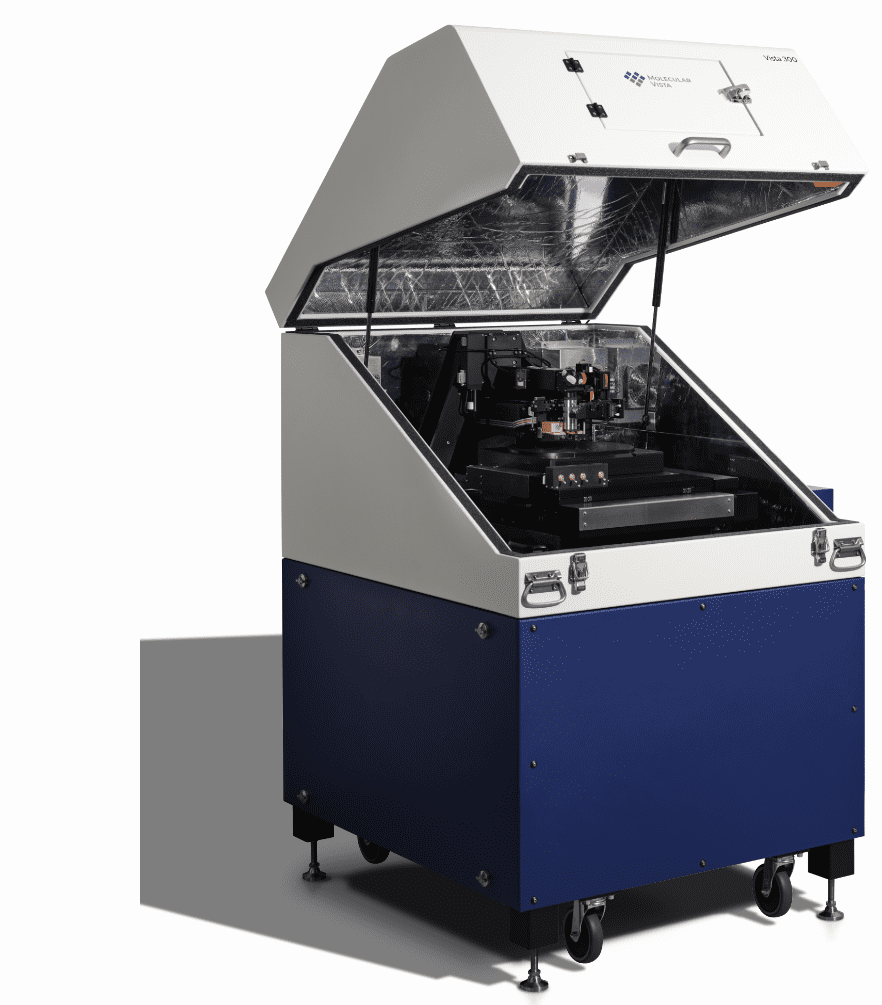
Vista 300 is the most advanced nano-chemical meteorology instrument designed for research and development (R&D) as well as failure analysis in nanofabrication. Its cutting-edge features and innovations make it an essential tool for professionals in the field.
AutoPiFM
- Automated Data Generation: AutoPiFM creates a comprehensive dataset from scratch, providing fixed-wavenumber PiFM images for every detected chemical component, as well as PiF-IR spectra in each chemical phase.
- Ease of Use: Simply set up AutoPiFM and let it handle the complex data generation, making your work easier and more efficient.
Automatic Alignment
- Computer Vision Technology: This industry-first feature uses computer vision to automatically align the excitation laser, ensuring optimal results with minimal user intervention.
- Time and Training Efficiency: Reduce training time and improve productivity with precise and reliable laser alignment.
Compact Footprint
- Integrated Design: Our automated beam alignment and integrated multiplexer allow for the lasers to be housed below the main instrument, resulting in a more compact and efficient design.
- Dual Laser Support: Vista 300 can support up to two lasers to cover the full infrared (IR) spectral range, enhancing its versatility (see specifications for details).
Controlled Environment
- Efficient Sample Handling: The 400 mm wide sample access door maximizes throughput while minimizing thermal disturbances that could cause drift.
- Stable Operating Conditions: The insulated metal enclosure ensures acoustic isolation and maintains stable temperature control within 0.1 °C, making it suitable for clean room environments.
Functionality
- Imaging modes: Non-contact AFM, PiFM, KPFM, cAFM, nano DMA, FvD (force vs distance) mapping.
- Spectroscopy modes: PiF-IR, FvD.
- PiF Laser Options: QCL (770 – 1840, 1995 – 2395 cm−1), OPO/DFG (590 – 2050, 2250 – 4400, 5000 – 7000 cm−1).
- Depth probed (IR): 20 nm in surface mode & greater than 100 nm in bulk mode.
Stage and scanner
- Sample stage travel: 200 mm × 200 mm square.
- Scan size: 120 µm × 120 µm.
- Dual Z Feedback: 12 µm z-scanner with 600 nm fast-z scanner provides both high bandwidth and a large z-range