

Pollux 2
This compact device integrates triaxial MEMS accelerometers and gyroscopes, a magnetometer, a barometer, and a multi-constellation GNSS receiver.
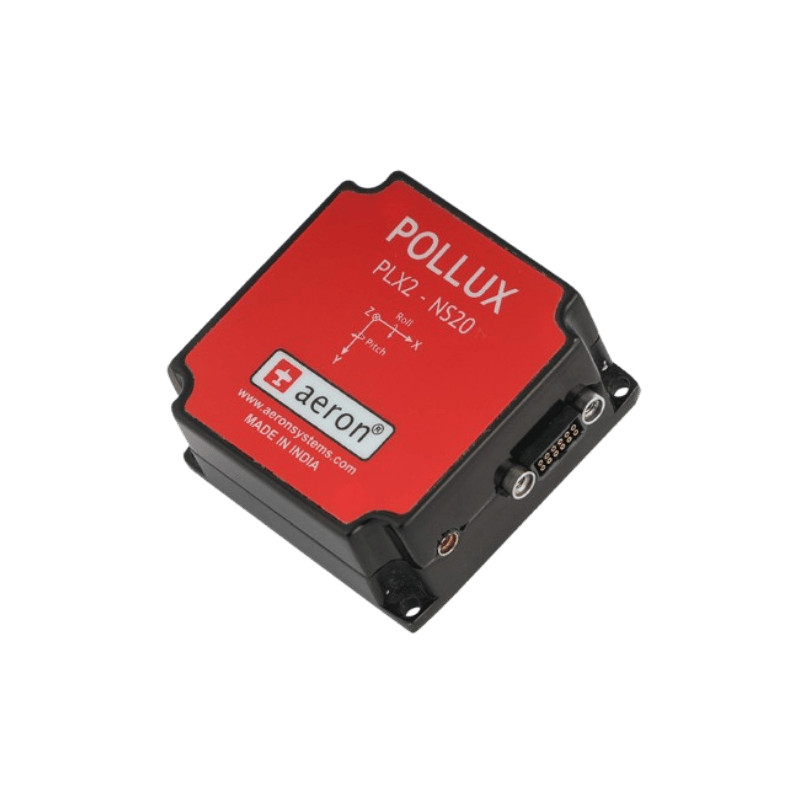
The POLLUX 2 from Aeron Systems is an advanced miniaturized inertial navigation system (INS) that provides high-precision positioning and navigation for autonomous and unmanned applications.
Main features of the POLLUX 2
Advanced accuracy: Offers position accuracy of 2 meters CEP and velocity accuracy of 0.2 m/s thanks to its multi-constellation GNSS and its sensor fusion engine based on an extended Kalman filter.
Ultra-compact and lightweight design: Dimensions of just 45 x 45 x 20 mm and a weight of 80 grams, ideal for drones, autonomous ground vehicles, robots, UGVs, and UUVs where space and weight are critical.
Low power consumption: Less than 2 W, perfect for battery-powered platforms and mobile applications.
Tactical robustness: Certified under MIL-STD-810G standard, withstands impacts up to 40g and is resistant to demanding environmental conditions (IP65 protection).
Versatile interfaces: Includes RS232, RS422, and USB connections, facilitating integration with professional autopilots such as Pixhawk and Ardupilot, as well as with next-generation control and navigation systems.
Advanced sensor fusion: Aeron Systems’ proprietary engine for precise estimation of position, velocity, and attitude, even during temporary GNSS outages.
Multi-platform applications: Ideal for navigation of drones, unmanned ground and aquatic vehicles, advanced robotics, autonomous guidance systems, ADAS, and real-time personnel tracking.
The POLLUX 2 from Aeron Systems is the ideal solution for those seeking a compact, robust, and precise INS, ready to be integrated into the most demanding autonomous navigation applications. Available at Milexia Ibérica. It provides reliable data on position, velocity, attitude, and heading even in GNSS-denied or limited-signal environments.
Highlighted applications of the Pollux 2
- Navigation and control of drones (UAVs) and autonomous vehicles (UGVs, UUVs)
- Integration into autopilot systems and robotic platforms
- Unmanned land, air, and maritime vehicles
- Navigation and guidance systems in defense and security
- Real-time personnel tracking and localization